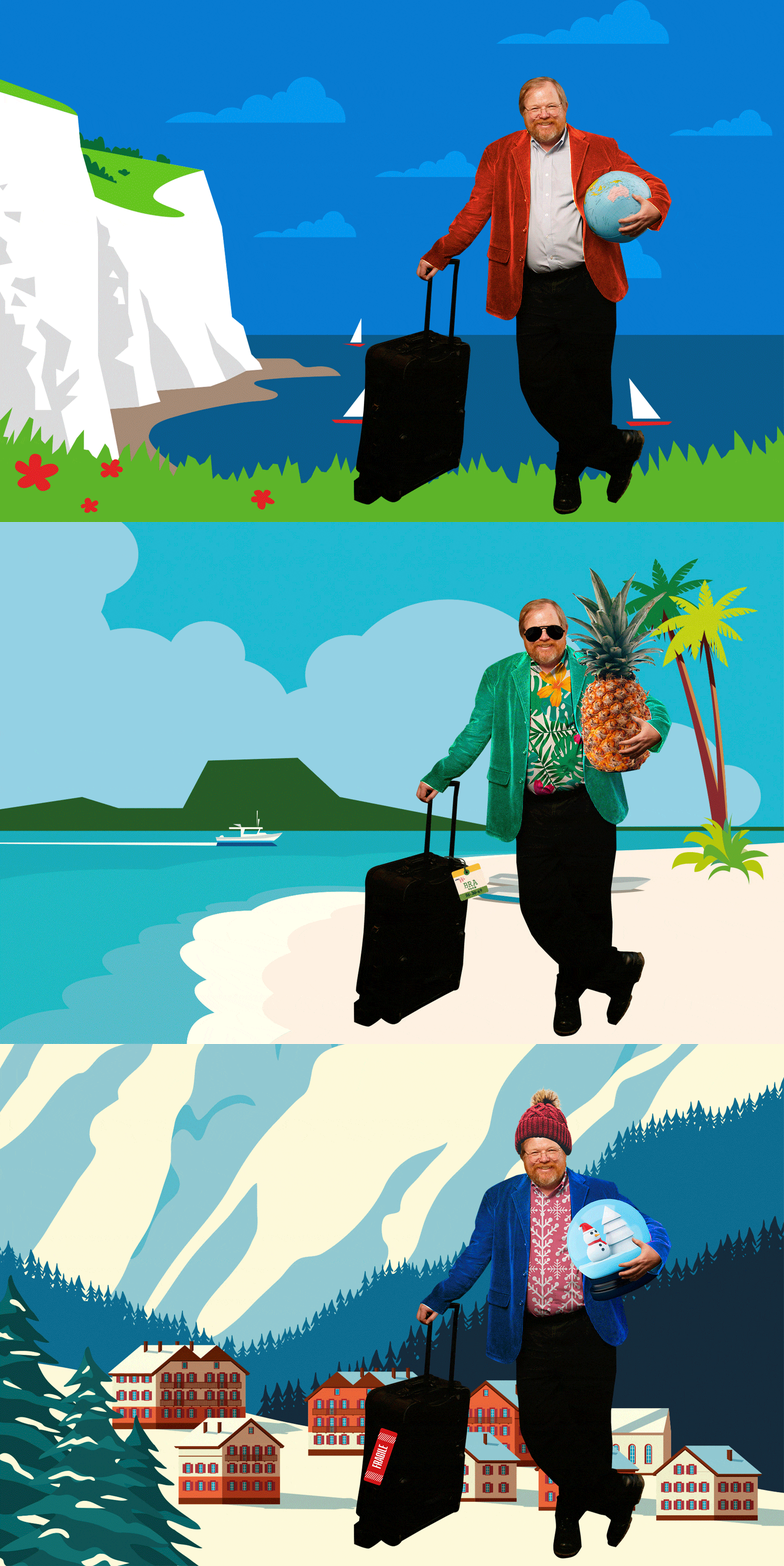
It's been 25 years since Bill Bryson proved – joyously and definitively – that only an outsider can see the whole truth about where you live.
In our case, finding out that a Johnny Foreigner – an American, no less! – could laugh at us in a way that made us laugh at ourselves came as delightful surprise.
Notes from a Small Island was about as endearing a portrait of British weirdness as you could hope to find (or in his words, “crazy as f***”) – a love-letter, really, to Bryson's adoptive home, where judges wear “little mops on their heads” and people call complete strangers "mate" or "love".
Ever since that book, Bryson has charmed readers from San Francisco to Farleigh Wallop with his heart-warming brand of avuncular lampoonery, travelling the world and taking the mickey.
But sadly now, after a dizzying writing career, he has announced his retirement. “Whatever time is left to me on this planet I’d like to spend it indulging myself, rather than going out and trying to cover new territory,” he told Times Radio .
So, all hail Bill Bryson – the most insightful, witty and warm-hearted travel writer of the last 25 years. To mark the occasion, here are 15 his best observations...
What a wondrous place this was - crazy as f***, of course, but adorable to the tiniest degree. What other country, after all, could possibly have come up with place names like Tooting Bec and Farleigh Wallop, or a game like cricket that goes on for three days and never seems to start?
I ordered a coffee and a little something to eat and savored the warmth and dryness. Somewhere in the background Nat King Cole sang a perky tune. I watched the rain beat down on the road outside and told myself that one day this would be 20 years ago.
The tearoom lady called me love. All the shop ladies called me love and most of the men called me mate. I hadn't been here twelve hours and already they loved me.
Bill Bryson (Author)
In 1995, before leaving his much-loved home in North Yorkshire to move back to the States for a few years with his family, Bill Bryson insisted on taking one last trip around Britain, a sort of valedictory tour of the green and kindly island that had so long been his home. His aim was to take stock of the nation's public face and private parts (as it were), and to analyse what precisely it was he loved so much about a country that had produced Marmite; a military hero whose dying wish was to be kissed by a fellow named Hardy; place names like Farleigh Wallop, Titsey and Shellow Bowells; people who said 'Mustn't grumble', and ‘Ooh lovely’ at the sight of a cup of tea and a plate of biscuits; and Gardeners' Question Time. Notes from a Small Island was a huge number-one bestseller when it was first published, and has become the nation's most loved book about Britain, going on to sell over two million copies.
Bill Bryson (Author)
#1 Bestseller in both hardback and paperback: SHORTLISTED FOR THE 2020 ROYAL SOCIETY INSIGHT INVESTMENT SCIENCE BOOK PRIZE
_______
'A directory of wonders.' - The Guardian
'Jaw-dropping.' - The Times
'Classic, wry, gleeful Bryson...an entertaining and absolutely fact-rammed book.' - The Sunday Times
'It is a feat of narrative skill to bake so many facts into an entertaining and nutritious book.' - The Daily Telegraph
_______
'We spend our whole lives in one body and yet most of us have practically no idea how it works and what goes on inside it. The idea of the book is simply to try to understand the extraordinary contraption that is us.'
Bill Bryson sets off to explore the human body, how it functions and its remarkable ability to heal itself. Full of extraordinary facts and astonishing stories The Body: A Guide for Occupants is a brilliant, often very funny attempt to understand the miracle of our physical and neurological make up.
A wonderful successor to A Short History of Nearly Everything, this new book is an instant classic. It will have you marvelling at the form you occupy, and celebrating the genius of your existence, time and time again.
'What I learned is that we are infinitely more complex and wondrous, and often more mysterious, than I had ever suspected. There really is no story more amazing than the story of us.' Bill Bryson
Bill Bryson (Author)
‘I come from Des Moines. Somebody had to’
And, as soon as Bill Bryson was old enough, he left. Des Moines couldn’t hold him, but it did lure him back. After ten years in England, he returned to the land of his youth, and drove almost 14,000 miles in search of a mythical small town called Amalgam, the kind of trim and sunny place where the films of his youth were set. Instead, his search led him to Anywhere, USA; a lookalike strip of gas stations, motels and hamburger outlets populated by lookalike people with a penchant for synthetic fibres. He discovered a continent that was doubly lost; lost to itself because blighted by greed, pollution, mobile homes and television; lost to him because he had become a stranger in his own land.
Bryson’s acclaimed first success, The Lost Continent is a classic of travel literature – hilariously, stomach-achingly, funny, yet tinged with heartache – and the book that first staked Bill Bryson’s claim as the most beloved writer of his generation.
Bill Bryson (Author)
It is the driest, flattest, hottest, most desiccated, infertile and climatically aggressive of all the inhabited continents and still Australia teems with life – a large portion of it quite deadly. In fact, Australia has more things that can kill you in a very nasty way than anywhere else.
Ignoring such dangers – and yet curiously obsessed by them – Bill Bryson journeyed to Australia and promptly fell in love with the country. And who can blame him? The people are cheerful, extrovert, quick-witted and unfailingly obliging: their cities are safe and clean and nearly always built on water; the food is excellent; the beer is cold and the sun nearly always shines. Life doesn’t get much better than this…
All that is really going in your mouth is texture and chemicals. It is your brain that reads these scentless, flavorless molecules and vivifies them for your pleasure. Your brownie is sheet music. It is your brain that makes it a symphony.
I’ve said it before in another book, but I believe it’s worth repeating: the only thing special about the elements that make you is that they make you. That is the miracle of life.
I come from Des Moines. Somebody had to.
Every time you breathe, you exhale some 25 sextillion (that’s 2.5 × 10²²) molecules of oxygen – so many that with a day’s breathing you will in all likelihood inhale at least one molecule from the breaths of every person who has ever lived.
Bill Bryson (Author)
The ultimate eye-opening journey through time and space, A Short History of Nearly Everything is the biggest-selling popular science book of the 21st century and has sold over 2 million copies.
'Possibly the best scientific primer ever published.' Economist
'Truly impressive...It's hard to imagine a better rough guide to science.' Guardian
'A travelogue of science, with a witty, engaging, and well-informed guide' The Times
Bill Bryson describes himself as a reluctant traveller, but even when he stays safely at home he can't contain his curiosity about the world around him. A Short History of Nearly Everything is his quest to understand everything that has happened from the Big Bang to the rise of civilization - how we got from there, being nothing at all, to here, being us.
Bill Bryson's challenge is to take subjects that normally bore the pants off most of us, like geology, chemistry and particle physics, and see if there isn't some way to render them comprehensible to people who have never thought they could be interested in science. As a result, A Short History of Nearly Everything reveals the world in a way most of us have never seen it before.
Bill Bryson (Author)
In At Home, Bill Bryson applies the same irrepressible curiosity, irresistible wit, stylish prose and masterful storytelling that made A Short History of Nearly Everything one of the most lauded books of the last decade, and delivers one of the most entertaining and illuminating books ever written about the history of the way we live.
Bill Bryson was struck one day by the thought that we devote a lot more time to studying the battles and wars of history than to considering what history really consists of: centuries of people quietly going about their daily business - eating, sleeping and merely endeavouring to get more comfortable. And that most of the key discoveries for humankind can be found in the very fabric of the houses in which we live.This inspired him to start a journey around his own house, an old rectory in Norfolk, wandering from room to room considering how the ordinary things in life came to be.
Along the way he did a prodigious amount of research on the history of anything and everything, from architecture to electricity, from food preservation to epidemics, from the spice trade to the Eiffel Tower, from crinolines to toilets; and on the brilliant, creative and often eccentric minds behind them. And he discovered that, although there may seem to be nothing as unremarkable as our domestic lives, there is a huge amount of history, interest and excitement - and even a little danger - lurking in the corners of every home.
Bill Bryson (Author)
Bill Bryson goes to Kenya at the invitation of CARE International, the charity dedicated to working with local communities to eradicate poverty around the world. Kenya, generally regarded as the cradle of humankind, is a land of stunning landscapes, famous game reserves, and a vibrant culture, but it also has many serious problems, including refugees, AIDS, drought and grinding poverty. It also provides plenty to worry a nervous traveller like Bill Bryson: hair-raising rides in light aircraft, tropical diseases, snakes, insects and large predators.
Bryson casts his inimitable eye on a continent new to him, and the resultant diary, though short in length, contains all his trademark laugh-out-loud wit, wry observation and curious insight.
All the author’s royalties from this book, as well as all profits, will go to CARE International.
Bill Bryson (Author)
WINNER: NATIONAL GEOGRAPHIC TRAVELLER READER AWARD FOR BEST TRAVEL BOOK OF THE YEAR 2016
WINNER: BOOKS ARE MY BAG READER AWARD FOR BEST AUTOBIOGRAPHY OR BIOGRAPHY 2016
Twenty years ago, Bill Bryson went on a trip around Britain to celebrate the green and kindly island that had become his adopted country. The hilarious book that resulted, Notes from a Small Island, was taken to the nation’s heart and became the bestselling travel book ever, and was also voted in a BBC poll the book that best represents Britain.Now, to mark the twentieth anniversary of that modern classic, Bryson makes a brand-new journey round Britain to see what has changed.
Following (but not too closely) a route he dubs the Bryson Line, from Bognor Regis to Cape Wrath, by way of places that many people never get to at all, Bryson sets out to rediscover the wondrously beautiful, magnificently eccentric, endearingly unique country that he thought he knew but doesn’t altogether recognize any more. Yet, despite Britain’s occasional failings and more or less eternal bewilderments, Bill Bryson is still pleased to call our rainy island home. And not just because of the cream teas, a noble history, and an extra day off at Christmas.
Once again, with his matchless homing instinct for the funniest and quirkiest, his unerring eye for the idiotic, the endearing, the ridiculous and the scandalous, Bryson gives us an acute and perceptive insight into all that is best and worst about Britain today.
I mused for a few moments on the question of which was worse, to lead a life so boring that you are easily enchanted, or a life so full of stimulus that you are easily bored.
It is a curious feature of our existence that we come from a planet that is very good at promoting life but even better at extinguishing it.
Perhaps it’s my natural pessimism, but it seems that an awfully large part of travel these days is to see things while you still can.
Hunters will tell you that a moose is a wily and ferocious forest creature. Nonsense. A moose is a cow drawn by a three-year-old.
Bill Bryson (Author)
In the company of his friend Stephen Katz (last seen in the bestselling Neither Here nor There), Bill Bryson set off to hike the Appalachian Trail, the longest continuous footpath in the world. Ahead lay almost 2,200 miles of remote mountain wilderness filled with bears, moose, bobcats, rattlesnakes, poisonous plants, disease-bearing tics, the occasional chuckling murderer and - perhaps most alarming of all - people whose favourite pastime is discussing the relative merits of the external-frame backpack.
Facing savage weather, merciless insects, unreliable maps and a fickle companion whose profoundest wish was to go to a motel and watch The X-Files, Bryson gamely struggled through the wilderness to achieve a lifetime's ambition - not to die outdoors.
Bill Bryson (Author)
Bill Bryson’s first travel book, The Lost Continent, was unanimously acclaimed as one of the funniest books in years. In Neither Here nor There he brings his unique brand of humour to bear on Europe as he shoulders his backpack, keeps a tight hold on his wallet, and journeys from Hammerfest, the northernmost town on the continent, to Istanbul on the cusp of Asia. Fluent in, oh, at least one language, he retraces his travels as a student twenty years before.
Whether braving the homicidal motorists of Paris, being robbed by gypsies in Florence, attempting not to order tripe and eyeballs in a German restaurant or window-shopping in the sex shops of the Reeperbahn, Bryson takes in the sights, dissects the culture and illuminates each place and person with his hilariously caustic observations. He even goes to Liechtenstein.
Bill Bryson (Author)
From one of our most beloved and bestselling authors, a vivid, nostalgic, and utterly hilarious memoir of growing up in the 1950s.
Born in 1951 in the middle of the United States, Des Moines, Iowa, Bill Bryson is perfectly positioned to mine his memories of a totally all-American childhood for 24 carat memoir gold. Like millions of his generation, Bryson grew up with a rich fantasy life as a superhero. In his case, he ran around the house wearing a jersey with a thunderbolt on it and a towel round his neck that served as his cape, leaping tall buildings in a single bound and vanquishing evildoers (in his head) as The Thunderbolt Kid.
Using his childhood fantasy life as a springboard, Bill Bryson recreates the life of his family in the 1950s in all its transcendent normality. In a period that saw the inexorable rise of television, the opening of Disneyland, the testing of the atomic bomb, and the explosion of choice in everything from food to cars, Bill Bryson's days followed in reassuringly cosy succession, enlivened by modest triumphs and disasters.
Warm and laugh-out-loud funny, The Rise and Fall of the Thunderbolt Kid is a modern classic, full of Bill Bryson's inimitable, pitch-perfect observations.
...........................................................................................................................................
'Seriously funny' The Sunday Times
'A funny, effortlessly readable, quietly enchanted memoir' Daily Mail
'A wittily incisive book about innocence, and its limits, but in no sense an innocent book... Like Alan Bennett, another ironist posing as a sentimentalist, Bryson can play the teddy-bear and then deliver a sudden, grizzly-style swipe' Independent
'Outlandishly and improbably entertaining... inevitably [I] would be reduced to body-racking, tear-inducing, de-couching laughter' New York Times
'Characteristic mixture of bemused wit, acerbic astonishment and sweet benevolence... His evocation of an era is near perfect: tender, hilarious and true' The Times
Bill Bryson (Author)
‘Funny, wise, learned and compulsive’ - GQ
Bill Bryson turns away from travelling the highways and byways of middle America, so hilariously depicted in his bestselling The Lost Continent, The Life and Times of the Thunderbolt Kid and Notes from a Big Country, for a fast, exhilarating ride along the Route 66 of American language and popular culture.
In Made in America, Bryson tells the story of how American arose out of the English language, and along the way, de-mythologizes his native land - explaining how a dusty desert hamlet with neither woods nor holly became Hollywood, how the Wild West wasn’t won, why Americans say ‘lootenant’ and ‘Toosday’, how they were eating junk food long before the word itself was cooked up - as well as exposing the true origins of the words G-string, blockbuster, poker and snafu.
‘A tremendously sassy work, full of zip, pizzazz and all those other great American qualities’
Will Self, Independent on Sunday
The rooms were small and airless and cramped. To make matters worse, somebody in our group was making the most dreadful silent farts. Fortunately, it was me, so I wasn’t nearly as bothered as the others.
When you write books for a living, you come to realize that while not all people who write to authors are strange, all people who are strange write to authors.
The pleasant fact is that the British are not much good at violent crime except in fiction, which is of course as it should be.
I refer of course to the soaring wonder of the age known as the Eiffel Tower. Never in history has a structure been more technologically advanced, materially obsolescent, and gloriously pointless all at the same time.