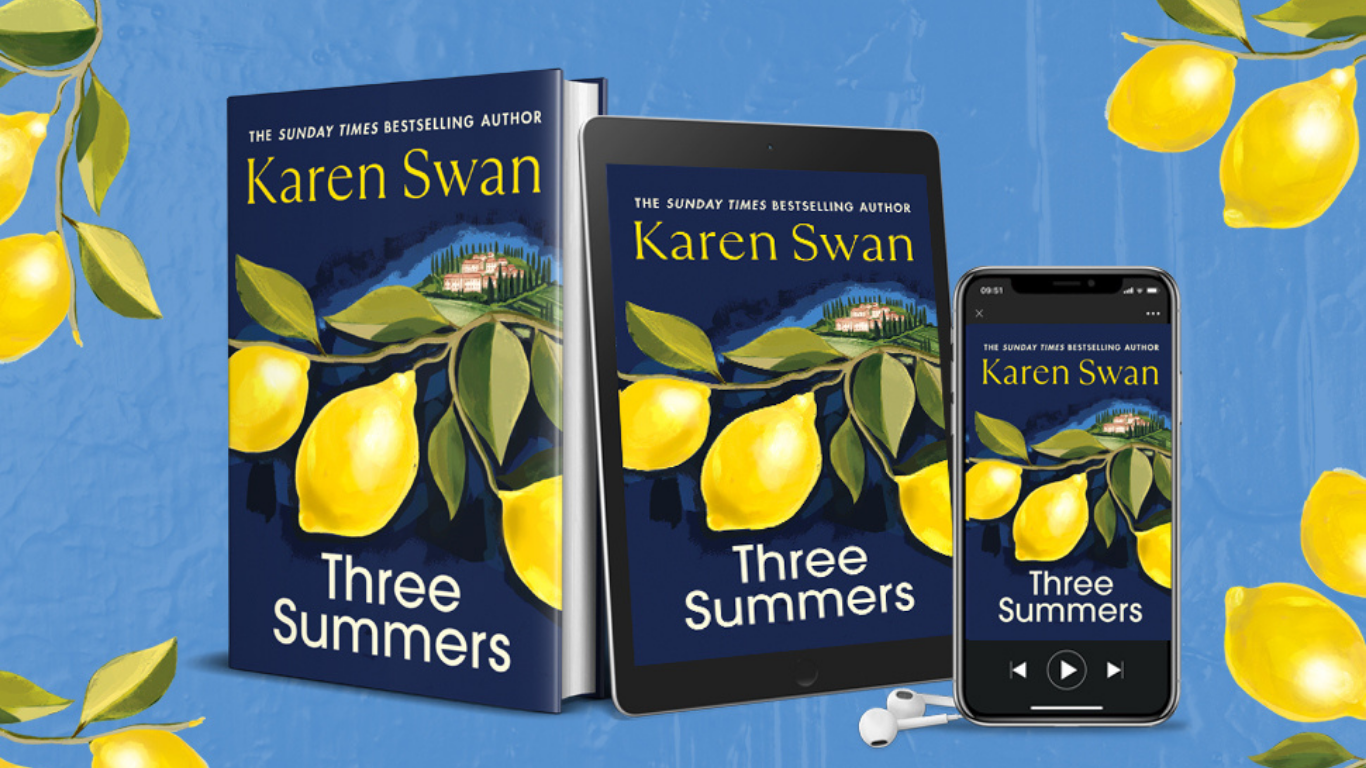
Extract: Three Summers by Karen Swan
Prologue
Agricola Parisi, Tricase Porto,
15 September 1957
The stone rolled, lumpen, over the terracotta tiles, coming to an abrupt stop by the door jamb. Instantly, the dawn settled herself upon it, throwing down warming sunrays in thick shafts, nudging at it fruitlessly with a fluttering, whimsical breeze.
Rafaella, motionless beneath a patched sheet, stirred as the echo of the quiet knock winged its way over to her bed. She rolled onto her back and stared blankly at the ceiling, watching the fan rotate as the beautiful day danced around the room, ready for her to play. And for half a moment she felt the sap rise within her, that instinctive reach for the brightness – before she remembered she was stuck in the shadows now. Death crowded every sense and blotted out the light; she was a creature mired in darkness.
Memories of those terrible days a few weeks ago clamoured in her drowsy mind and she closed her eyes against them, but they only glowed more vividly behind her eyelids, mournful scenes flashing in rapid succession. A crimson tide in the moonlight; a shoeless foot; moist earth freshly heaped in banks beside an open grave; the porcelain whiteness of a mother’s frozen visage; a coffin lowered on ropes; the nonnas’ black lace mantillas hanging forward as their tears dropped to the grass . . . She could still hear the cries, too, the wails and screams and then the crushing silence that seemed to follow after horror, when words were simply not enough.
That hadn’t been the end of it. There had been more to endure: questions and investigations, rumours and accusations . . . The plan was getting them through, but at what cost? Their desperate grasp for freedom had, ironically, cost them exactly that, and with every day that passed the outlook was becoming bleaker.
The sudden sun- up crescendo of the cicadas ushered in daybreak like a symphonic orchestra and she rolled onto her side, looking dully towards the vista that spread far and wide beyond her open French doors. It was the view she had known her entire life, both a comfort and a blessing: every morning she awoke to the sight of red earth and starlings, the neat lines of ancient olive groves stretching over the hills and tucking into the horizon. But today there was something more. Her gaze fell to the rogue stone on the balcony floor. It was crudely wrapped with a sheet of paper and tied with string. For several seconds she stared at it, knowing it could only have been thrown by one of two people; knowing it either contained very good news or very bad . . .
She rose from her bed, crossed the room and sank onto her haunches, picking up the stone and holding it in her palm like a baby bird. Already she could see the noble crest through the paper, and her heart began to pound as her fingers fumbled with the loose knot.
Very good news or very bad.
She pulled on the string and the stone rolled, unfurling from its parchment coat. She turned the paper over and her eyes fell upon two words.
Forgive me.