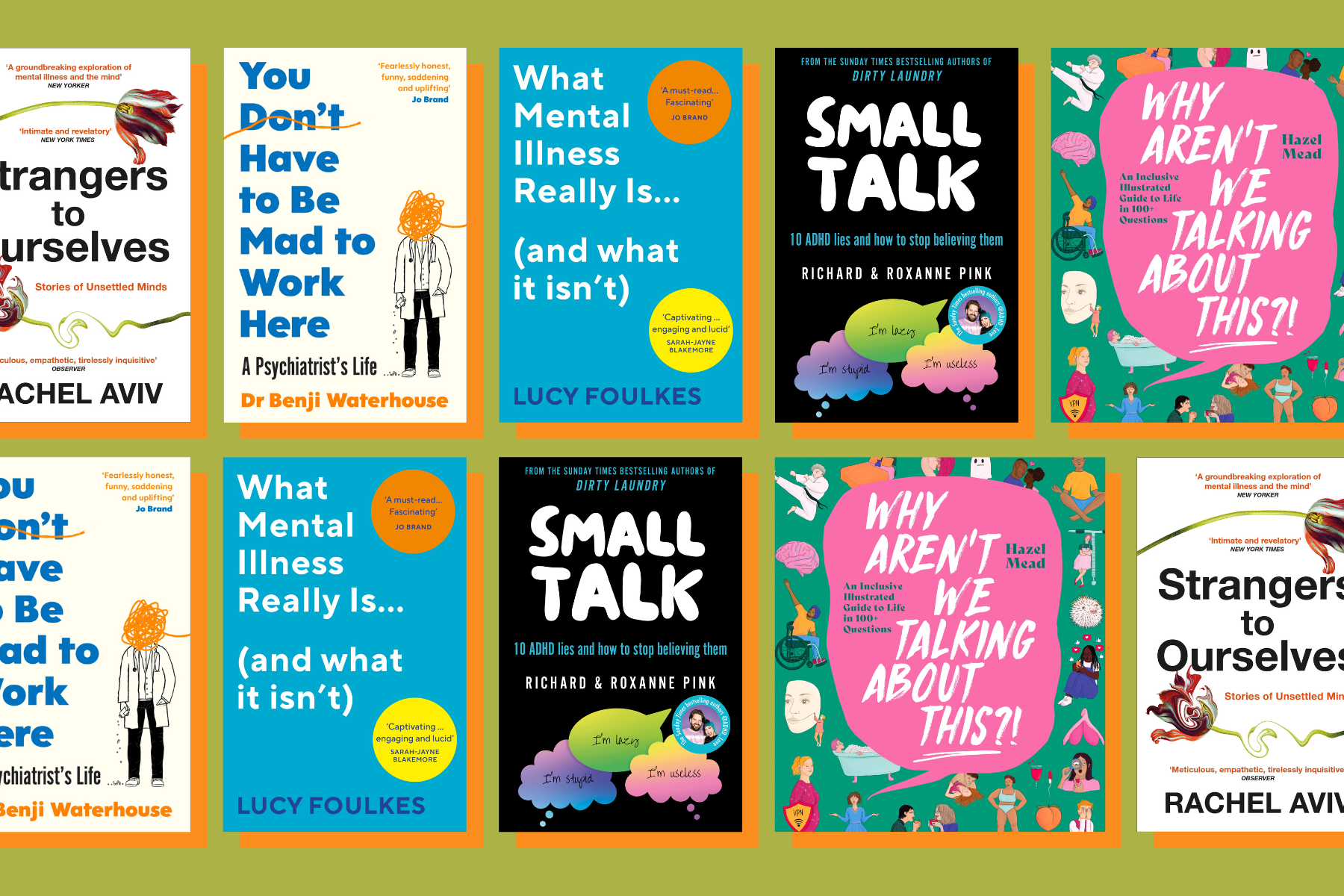
Books can support and inspire us, especially at difficult times in our lives. We can read to challenge society’s views of mental illness, to embrace challenging emotions like grief and shame, to deepen our understanding of neurodiversity and more. So for Mental Health Awareness Week (13-19 May, 2024), we have put together a reading list of books that look at mental health and well-being from a wide variety of angles.
Whether you are looking for an illustrated guide to life, a powerfully moving memoir or a deep-dive into psychology, these books will help if you are keen to understand more about yourself and those around you.
Most of the psychiatric cases in this book are his patients. Some of them are family. One of them is him.
Unlocking the doors to the psych ward, NHS psychiatrist Dr Benji Waterhouse provides a fly-on-the-padded-wall account of medicine’s most mysterious and controversial speciality.
Is the UK really experiencing a ‘mental health crisis’? In What Mental Illness Really Is... , psychologist Lucy Foulkes argues that we need to rethink the national conversation around mental illness. Drawing on extensive knowledge of the scientific and clinical literature, Foulkes writes with nuance and compassion on mental health, arguing for the necessity of a distinction between normal levels of stress, anxiety and sadness, and the diagnosis of a disorder. This is an essential book for anyone seeking clarity on the truth of mental illness.
Small Talk
With candour and kindness, they share personal stories to highlight and reframe the 10 big lies that ADHD people believe about themselves. From ‘I am lazy’ to ‘Everybody hates me’ and ‘I quit everything I start’, Small Talk Small Talk
In his powerful coming-of-age memoir, Mohsin Zaidi writes about his experiences of growing up gay in a strict Muslim household. Believing that it was impossible to be himself at home or school, and then feeling out of place in a different way when he became the first person from his school to gain admission to the University of Oxford, Zaidi’s mental health suffered blow after blow. A Dutiful Boy is the hopeful story of his journey from his lowest point to a life of belonging, love, family acceptance, and a career as one of the top criminal barristers in the UK.
Hazel Mead asks why we turn to Google to ask the most personal questions and offers us an alternative, in this illustrated guide to life in 100+ questions. There is a diverse range of questions that we are too afraid to ask, including how to spot green flags in potential relationships, how to deal with grief, how to prepare for a cervical screening and how to practice self-defence. Hazel Mead encourages us to embrace our own uniqueness.
Strangers to Ourselves is an exploration of illness and the mind. Looking at the ways in which we understand ourselves in times of distress, this book draws on stories of individuals with unique experiences. With research spanning cultures and continents, Rachel Aviv shows the breadth of human experience and urges us to rethink the connections between our physical and mental health.
As a beautiful examination of grief, A Blood Condition is a moving, musical poetry collection that responds to change and permanence, loss and joy, and the ongoing process of letting go. Kayo Chingonyi is a remarkable voice whose words will strike a chord with anyone who has experienced the loss of a loved one.
If you need mental health help or advice, you can seek support on Mind’s website , or by phoning their information helpline on 0300 123 3393. For urgent support, call NHS 111.