- Home
- Discover
- Children's articles
- ‘At his best, Terry was a teacher’: Why we love Terry Pratchett
‘At his best, Terry was a teacher’: Why we love Terry Pratchett
A year on from the 50th anniversary of Pratchett’s debut novel The Carpet People, we celebrate his birthday by asking authors, editors, and fans about the enduring impact of his work and how it touched their lives.

“In the beginning… there was nothing but endless flatness...” then Terry Pratchett published his first book, The Carpet People, in 1971 at the age of 23. Marked by a launch party in the carpet department of Heal’s on Tottenham Court Road, Pratchett's debut novel follows a civilisation of people who live among the fronds of a carpet. But their existence is not a simple one: there are conflicts between the different tribes; there is the destructive force of the Fray, and there are taxes.
But Pratchett didn’t stop at the far reaches of the carpet. His imagination and penchant for satire spawned the expansive and immensely popular 41-novel Discworld series (which is now available on audiobook), various standalones, short stories, as well as several unfinished works on his hard drive (which has since been crushed under a steamroller, as per the late Pratchett’s wishes).
Although Pratchett took Death’s arm back in 2015, putting a heartbreaking stop to any more tales, there is so much to forever enjoy, discuss, share and pass along from his catalogue. Here, a handful of fellow authors and fans share their thoughts about the master fantasy writer.
Naomi Ishiguro, author of The Rainshadow Orphans
Sir Terry Pratchett’s Tiffany Aching novels were key to my emotional development as a young person. Tiffany is an outstanding role model, with her strength, and also her belief in taking responsibility for the wellbeing of everyone within her community, not because this will bring her prestige, glamour or external reward, but simply because it is right.
'Tiffany [Aching] is an outstanding role model'
As a teenager, I was so struck by this character who could so calmly ignore society’s flightier, shinier values to get on with the hard, frequently thankless work of pursuing her own principles of compassion, open-mindedness and dignity for all people.
And even still, whenever I have to face a tough situation in life, I picture the witch’s hat on my head and know that whatever nonsense it is that I’m facing, there’s formidable strength to be found in staying true to your sense of self, and upholding your core values - just as Tiffany always does.
Val McDermid, author of Silent Bones
I once had to buy a suitcase on a book tour. It had four wheels and a mind of its own. I went right, it went left. I went straight on, it veered in random directions. And because I was in America and Homeland Security searched it whenever I flew, my clothes were configured differently whenever I opened it.
Inevitably, I christened it ‘The Luggage’ after Terry Pratchett’s sapient pearwood invention. And that for me is the key to Pratchett’s fantasy. It always has recognisable reality stitched into it, so people like me who don’t read much fantasy feel at home in Discworld. Pratchett is a savage satirist, but that’s always tempered by breath-taking inventiveness, both in language and characterisation – like the Nac Mac Feegles, the belligerent blue midget warrior tribe, whose cod Scottishness has always made me laugh inappropriately in public places. I always read Pratchett on book tours – the perfect antidote to being alone and far from home.
Sir David Jason, actor and audiobook narrator
The Colour of Magic [is my favourite Sir Terry Pratchett novel] as I love the character Rincewind, which I was lucky enough to play for a Sky Production. He is such an irascible and often feeble character, but he has heart and warmth which I hope came across from the novel. There are so many wonderful cameo roles in there too, such as the walking luggage and the living camera. There is such a richness to the imagination of this novel in particular, but I know this is the same for all of Terry Pratchett’s work.
'I actually came to Terry Pratchett quite late in life. Let’s just say over the age of 50'
I try and read a Terry Pratchett novel as often as I can, but I know I have a lot of catching up to do. I actually came to Terry Pratchett quite late in life. Let’s just say over the age of 50, but that’s one of the qualities about the writing, as it can appeal to readers of all ages.
My friend Brian Cosgrove, the animator, gave me my first copy of The Colour of Magic as being an artist and animator he loved the imagery and imagination of the many visuals described in the book - and he knew I would probably appreciate it too.
Terry Pratchett’s influence in my work is to try and be as imaginative as possible as on-screen anything is possible. We shouldn’t be bound by reality as we are telling a story. We should suspend belief in order to make a film or programme as entertaining as possible.
I would probably say the description of the Discworld [is my favourite quote] as the thought of all the different component parts of this other world is so strong and imaginative. To think that the fantasy world is balanced on the back of four elephants in turn balanced on a giant turtle is so surreal and colourful, but then that is what Terry Pratchett was famous for; humour, imagination and wonderful fantasy.
Dave Rudden, author of Knights of the Borrowed Dark
I first read Mort at 11 years old. It wasn’t my first fantasy book by any stretch, but it was the first fantasy book I ever read where I realised the author was using their world to say something about ours. It felt like he was speaking to me – like a wise, sharp, very funny uncle reaching out to let me in on a secret – and after reading it I felt a little wiser and a little sharper too.
Saying ‘I love Death’ would normally be a cause for raised eyebrows in polite society, but only someone as smart and kind as Pratchett could turn something everybody fears into a kindly grandfather character who is nice to kittens and enjoys a good curry now and then. Death is not evil, he’s just very good at his job. But he’s also kind, and patient (very patient) and has a sense of justice that only seeing the best and worst of people can provide.
I remember once reading an article by Neil Gaiman about how everyone viewed Terry Pratchett as kind and jolly when actually he was often very angry. Angry at injustice. Angry at people. Angry at himself, or at circumstance, or at the world. We’re often told that anger is bad, which is a problem because anger is everywhere. It’s around us and inside us, and we can either pretend it isn’t (which only makes it worse) or we can use it as fuel. We can use it to help people. We can use it to keep us warm when the world is hard and cold and use it to change things so that other people don’t have to be as angry in days to come.
'The best advertisement for Pratchett is Pratchett. You hear one line, you’re hooked'
Terry Pratchett’s books are, without a doubt, fun to read. They’re packed full of jokes, and ridiculous characters, and silly little winks to the audience. You know that feeling you get when a friend you love is telling you a story, and the story cracks them up so much that you both start laughing too much to get to the end, even though you haven’t heard the punchline? That sense of delight?
I have been reliably informed that I have the energy of a corgi trapped in Christmas lights, and for a long time in my writing I tried to be serious, and adult, and sound important, because I was worried that people wouldn’t listen to me if I sounded like myself. Now, I try and bring the fierce joy of Pratchett to my own work. If I want to be a little ridiculous, if I want to take a chance on a description, or tell a story within a story, I trust the reader to be swept up in that same delight. I try and capture that feeling of ‘we’re in this together’ that he so effortlessly displayed.
When it comes to encouraging someone to read Pratchett, I generally let Pratchett do it for me. I tell them about the Death of Rats (Reaper Man), or the Music with Rocks In (Soul Music), or the shy banshee (Moving Pictures) who slips notes with "OOOOeeeOOeeeeOOOOee" under people’s door. I tell them about Moist Von Lipwig (Going Postal) tricking the world into thinking he’s a hero and getting tricked into believing it himself.
The best advertisement for Pratchett is Pratchett. You hear one line, you’re hooked.
Which book would I recommend to everyone? BIG question. Mort is generally accepted as the easiest entrypoint for newcomers to Discworld – Pratchett’s world-building had nicely caramelised at that point from the wilder bubblings of the earlier books. Age, for me, isn’t really a factor with Pratchett. You can start with his younger work in your 50s, or jump right into Wyrd Sisters at 10, and unlock more and more detail and meaning as you read and reread his books. It’s a gorgeous head to grow up in, believe me. I’m really glad I did.
C.K. McDonnell, comedian and author of The Stranger Times series
I always have a Terry Pratchett book on the go – finishing one and starting the next – because it’s a constant source of comfort, a reminder that nothing can be entirely bad while Discworld is within reach (even during bouts of theatrical “man flu”). So being asked to choose favourites feels both necessary and impossible: any selection is bound to frustrate, shaped as much by mood as merit, and limited by the fact that it has to exist in the real world rather than the infinitely flexible logic of L-Space.
'Certain Discworld novels rise to the surface for the way they combine humour with something sharper and more enduring'
Still, certain Discworld novels rise to the surface for the way they combine humour with something sharper and more enduring. There’s the thrill of a perfectly crafted opening and a redemption story laced with anger at unchecked systems, the quiet force of ideas like Vimes’ “boots” theory and moments that land with unexpected emotional weight, and the richness of Ankh-Morpork itself – never just a setting, but a living, breathing centre of the series. Some books resonate for more personal reasons, capturing the energy of music or the pull of creative life, while others celebrate the ideals of truth-telling and the importance of a free press. Any attempt to define “favourites” inevitably leaves out entire corners of Discworld – witches, watchmen, wizards and more – but that’s part of the joy: there’s always another one waiting to be picked up.
Robin Stevens, author of the Murder Most Unladylike books
I was a big fan of the whole Tiffany Aching series as a teenager, but the story that really stands out for me is A Hat Full of Sky. I first read it when I was 16, and then reread it again when I was 29.
What struck me both times is how wonderfully well Terry Pratchett understands human beings. The Discworld might be made up, but it has always felt absolutely real because the people in it don't behave like characters - they behave like fully-rounded human beings.
Tiffany is very special to me precisely because she's a hero who isn't very (traditionally) heroic. She's grouchy and sharp and not perfect at all - and that's not presented as a problem. She still gets to be the centre of her story, and she still gets to save the world!
She made me see that I could create my own smart, imperfect heroines - there's a bit of Tiffany in both Daisy and Hazel from my Murder Most Unladylike series.
Listen to the Discworld audiobooks here.
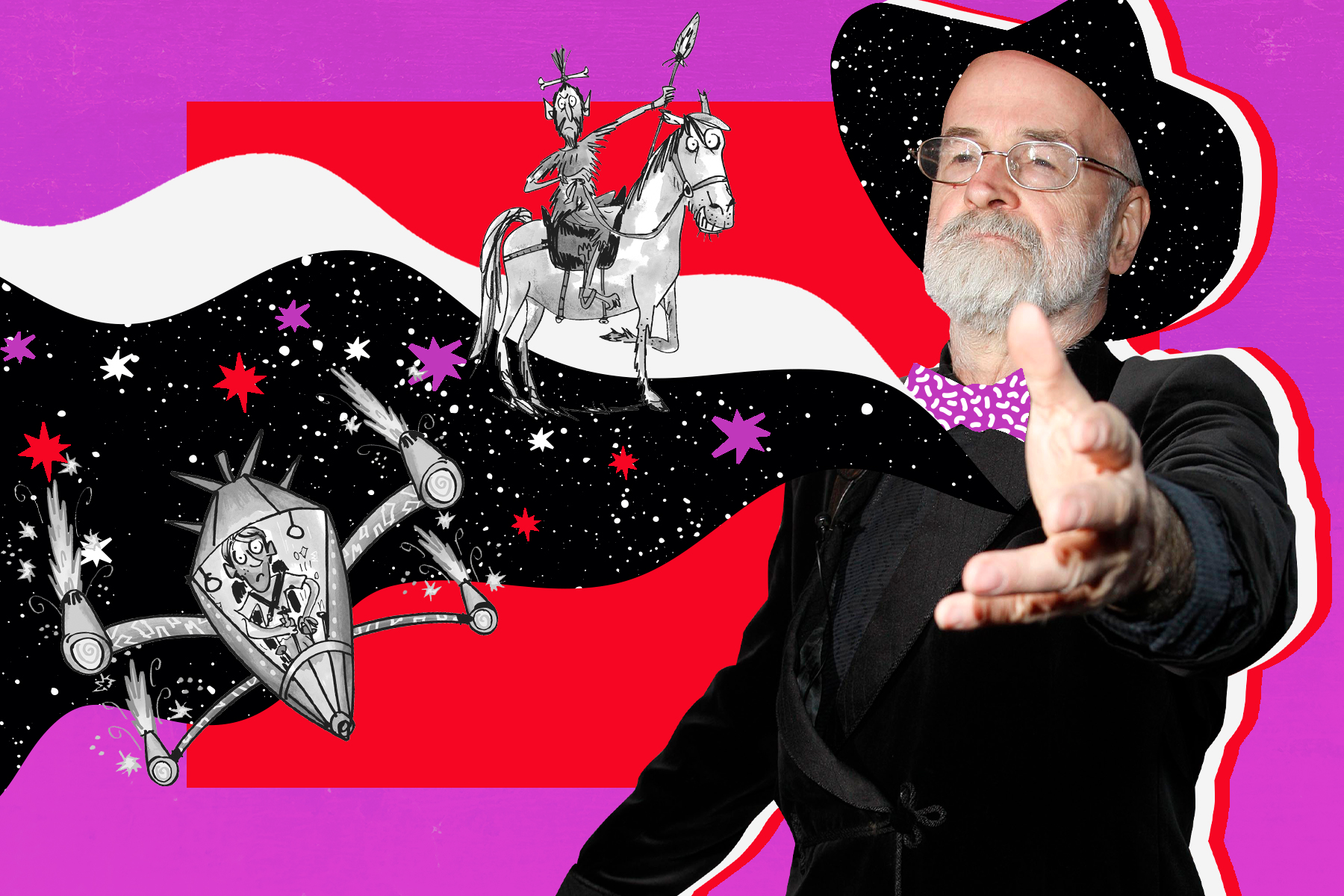
Image: Alicia Fernandes / Getty Images / Illustrations by Mark Beech