Join our newsletter for 10% off at the Penguin Shop

Inspector Maigret

by75 books in this series
Book cover of Maigret in New York by Georges Simenon

Maigret in New York

'Compelling, remorseless, brilliant' John Gray

What was it about him that had struck Maigret so forcefully? . . . Little John had cold eyes! . . . Four or five times in his life, he had met people with cold eyes, those eyes that can stare at you without establishing any human contact.

Persuaded to sail to New York by a fearful young law student, Maigret finds himself drawn into the city's underworld, and a wealthy businessman's closely guarded past.

'One of the greatest writers of the twentieth century . . . Simenon was unequalled at making us look inside, though the ability was masked by his brilliance at absorbing us obsessively in his stories' Guardian
Book cover of Maigret Gets Angry by Georges Simenon

Maigret Gets Angry

‘Acute psychological insight and a distinctive, spare, atmospheric style … Simenon ought to be spoken of in the same breath as Camus, Beckett and Kafka’ Independent on Sunday


In this classic novel, a dramatic case unfolds while Inspector Maigret is visiting colleagues in America

‘The FBI man was convinced, in short, that Maigret was a big shot in his own country but that here, in the United States, he was incapable of figuring out anything’

Inspector Maigret is touring the United States to observe American policing methods, when a visit to a troubling coroner’s inquest in Arizona sparks a fascination with the story of a young girl and five airmen in the desert.


'One of the greatest writers of the twentieth century' Guardian


‘Gem-hard soul-probes . . . not just the world's bestselling detective series, but an imperishable literary legend’ Boyd Tonkin, The Times

Book cover of Félicie by Georges Simenon

Félicie

In his mind's eye he would see that slim figure in the striking clothes, those wide eyes the colour of forget-me-not, the pert nose and especially the hat, that giddy, crimson bonnet perched on the top of her head with a bronze-green feather shaped like a blade stuck in it . . . Félicie had given him more trouble than all the 'hard' men who had been put behind bars.
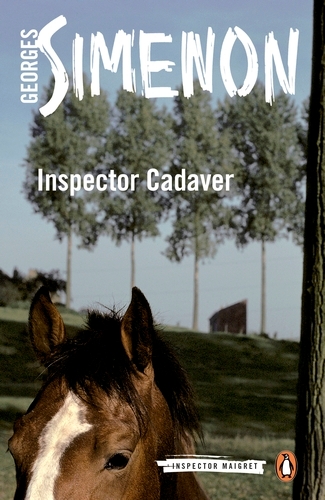
Book cover of Inspector Cadaver by Georges Simenon

Inspector Cadaver

In everyone's eyes, even the old ladies hiding behind their quivering curtains, even the kids just now who had turned to stare after they had passed him, he was the intruder, the undesirable. No, worse, he was fundamentally untrustworthy, some stranger who had just turned up from who knew where to do who knew what.
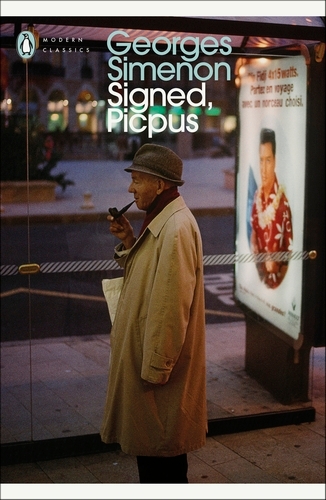
Book cover of Signed, Picpus by Georges Simenon

Signed, Picpus

Mechanically, he had put his pince-nez down on the blotter and looked at it there with his large, short-sighted eyes. It is at that moment that the strange thing happens. One of the lenses, acting as a mirror, reflected the criss-cross, hatched ink marks which had dried on the blotter and he could just make out a couple of words.
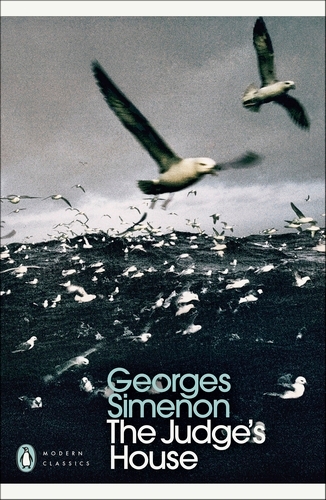
Book cover of The Judge's House by Georges Simenon

The Judge's House

A short, sprightly man appeared in the doorway, looked left and right, and went back into the passage. A moment later, the improbable happened. The little man reappeared, bent over, clinging to a long mass that he now started dragging through the mud.

It must have been heavy. After four metres, he stopped to catch his breath. The front door of the house had been left open. The sea was still twenty or thirty metres away.
Book cover of The Cellars of the Majestic by Georges Simenon

The Cellars of the Majestic

Try to imagine a guest, a wealthy woman, staying at the Majestic with her husband, her son, a nurse and a governess . . . In a suite that costs more than a thousand francs a day . . . At six in the morning, she's strangled, not in her room, but in the basement locker room . . . In all likelihood, that's where the crime was committed . . . What was the woman doing in the basement? . . . Who could have lured her down there, and how? . . . Especially at an hour when people of that kind are usually still fast asleep . . .
Book cover of Cécile is Dead by Georges Simenon

Cécile is Dead

‘Acute psychological insight and a distinctive, spare, atmospheric style … Simenon ought to be spoken of in the same breath as Camus, Beckett and Kafka’ Independent on Sunday

In this classic novel, a woman’s fears for her safety lead Inspector Maigret to a Paris suburb where he uncovers appalling family secrets


‘Barely twenty-eight years old. But it would be difficult to look more like an old maid, to move less gracefully…those black dresses…that ridiculous green hat!’

For six months the dowdy Cécile has been coming to the police station, desperate to convince them that someone has been breaking into her aunt’s apartment. No one takes her seriously – until Maigret unearths a story of merciless, deep-rooted greed.


'One of the greatest writers of the twentieth century' Guardian


‘Gem-hard soul-probes . . . not just the world's bestselling detective series, but an imperishable literary legend’ Boyd Tonkin, The Times
Book cover of Maigret by Georges Simenon

Maigret

Maigret shrugged his shoulders, buried his hands in his pockets and went off without answering. He had just spent one of the most wretched days in his life. For hours, in his corner he had felt old and feeble, without idea or incentive. But now a tiny flame flickered. 'You bet we'll see' he growled.

Maigret's peaceful retirement in the countryside is disrupted when a relative unwittingly embroils himself in a crime he did not commit and the retired inspector returns to Police Headquarters in Paris once again.
Book cover of Lock No. 1 by Georges Simenon

Lock No. 1

Cars drove past along with the trucks and trams, but by now Maigret had realised that they were not important. Whatever roared by like this along the road was not part of the landscape. ... What really counted was the lock, the hooting of the tugs, the stone crusher, the barges and the cranes, the two pilots' bars and especially the tall house where he could make out Ducrau's red chair framed by a window.

Maigret is drawn into the orbit of the self-made, mercurial Ducrau, as the latter's past catches up with him.
Book cover of Liberty Bar by Georges Simenon

Liberty Bar

Half an hour later, he was in Cannes ... White everywhere! Huge white hotels, white shops, white trousers and dresses, white sails out at sea.
It was as if life were no more than a pantomime fairy-tale, a white and blue fairy-tale.

Dazzled at first by the glamour of sunny Antibes, Maigret soon finds himself immersed in the less salubrious side of the Riviera when he traces the steps of a shabby former spy who is fond of pretty women and dive bars.
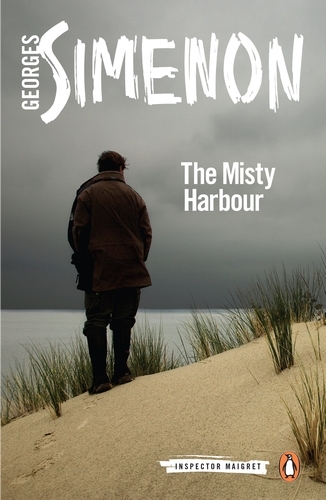
Book cover of The Misty Harbour by Georges Simenon

The Misty Harbour

A man picked up for wandering in obvious distress among the cars and buses on the Grands Boulevards. Questioned in French, he remains mute . . . A madman? In Maigret's office, he is searched. His suit is new, his underwear is new, his shoes are new. All identifying labels have been removed. No identification papers. No wallet. Five crisp thousand-franc bills have been slipped into one of his pockets.
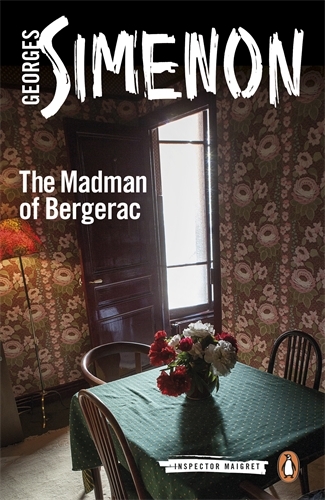
Book cover of The Madman of Bergerac by Georges Simenon

The Madman of Bergerac

He recalled his traveling companion's agitated sleep - was it really sleep - his sighs, and his sobbing. Then two dangling legs in their patent leather boots and hand-knitted socks . . . A lacklustre face. Glazed eyes. And Maigret was not surprised to see a grey beard eating into his cheeks.
Book cover of The Flemish House by Georges Simenon

The Flemish House

Maigret goes to the Belgian border to investigate the disappearance of a young woman.
Book cover of The Saint-Fiacre Affair by Georges Simenon

The Saint-Fiacre Affair

The Countess of Saint-Fiacre dies from heart failure during mass on All Soul's day, exactly when the police had been forewarned that a crime would occur.
Book cover of The Shadow Puppet by Georges Simenon

The Shadow Puppet

On a corner of the desk, the police gazette lay open, showing twenty or so photographs of wanted individuals. Most of them faces of thugs. Heads that bore the scars of degeneracy . . . And the warning, in red, Dangerous. Is still armed. A fellow who would not sell himself cheaply.

Well! Maigret would have preferred that to all this syrupy greyness, to these family sagas, to this still inexplicable murder which he found mind-boggling.