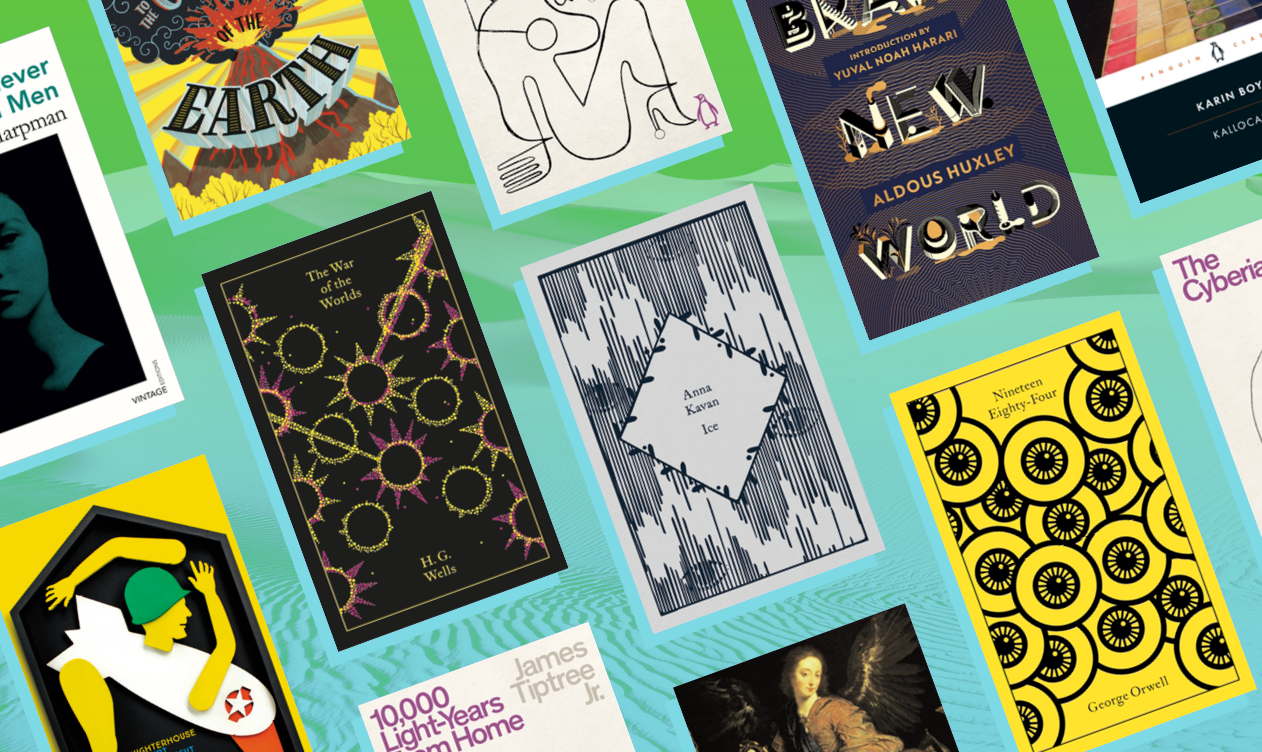
As the world gets weirder and weirder, science fiction seems increasingly plausible. That’s because, however outlandish their inventions, stories of science fiction are about people, who never change, and about the times they were written in. The best science fiction – including dystopian fiction – can fire our imagination with new worlds at the same time as making us look inward. Here are some of Penguin’s must-read science fiction classics, from 17th century fantasias to a world of hair-carpet weavers.
When other 19th-century novelists were writing social realism, France’s great prolific literary adventurer was exploring other worlds. This one, part of Verne’s ‘Voyages extraordinaires’ series that combined scientific facts with exciting quests, has everything: intrepid explorers, mysterious runes, a silent guide and, of course, lots of fireballs and monsters. Verne’s inexhaustible imagination also gave us gems like 20,000 Leagues Under the Sea
Subtitled ‘A Novel from the 21st Century’, this is one of the few dystopian novels that acknowledges the sexist aspects of totalitarian regimes. The Kallocain of the title is a truth drug, invented by a man loyal to the novel’s World State, but the book itself was an act of freedom. Writing it made Boye nervous that it could spark an invasion of neutral Sweden by Nazi Germany – but she followed her heart and published it anyway.
It’s one of the most famous novels of the last century, inventing more everyday phrases – Big Brother, Room 101 – than any other, but as with any classic, you don’t really know it until you’ve read it. The story of Winston Smith and his attempts to resist the power of the controlling government in a future England is gripping and devastating, and an evergreen reminder of the risks of not thinking for yourself. See also: Animal Farm
This small masterpiece is a brilliant example of how to keep the reader guessing, as the story is revealed bit by bit. In a faraway city, every man must weave a carpet from the hair of his daughters, and when he dies, his son will continue the tradition – but only when the story zooms out from city to planet, then from galaxy to universe, do we finally find out why. This compelling, original story makes us see ourselves in an entirely new light.
Cavendish, the Duchess of Newcastle, was a riot and a whirlwind in 17th-century England: “Britain’s first literary celebrity,” in the words of her biographer. Among her many achievements were this utopian science fiction romance where a woman is kidnapped into a world of talking animals, and becomes a military leader. Cavendish challenged expectations of women (“I do not like her at all,” wrote Samuel Pepys ), but her work has endured.
You can also find The Blazing World in the Penguin Archive series, a collection of titles published by Penguin over the span of 90 years.
“Deep underground, thirty-nine women live imprisoned in a cage” – it’s quite a blurb, but the novel more than lives up to it, with its dystopian story of how freedom can be even more frightening than imprisonment. Reminiscent of Ishiguro’s Never Let Me Go as an allegory of the limitations and ignorance of our lives, this is one of the strongest, strangest books you’ll read.
Huxley’s novel of a dystopian futuristic world is usually lumped together with Nineteen Eighty-Four , but Brave New World is much funnier and more satirical than Orwell’s masterpiece. In this vision, people are kept quiet not by fear but by happiness, through sex, drugs, and all the other distractions that were as relevant in the 1930s as they are now. But some people want to forge their own happiness, and that’s where the problems begin…
Polish writer Lem is best known for his brain-bending novel Solaris , but the most striking thing about his other books is how funny they are (Lem was a big influence on Douglas Adams ). The collection of stories here is a perfect example: two human engineers struggle with their own inventions, like the machine that insists two plus two equals seven: it escalates into a comic battle, but it also represents totalitarian states where false information becomes the approved reality.
“All this happened, more or less.” Vonnegut took his wartime experiences of witnessing the firebombing of Dresden and turned them into a time-travel science fiction tragicomedy. The story of soldier Billy Pilgrim is told in simple language and a complex structure, and like all Vonnegut’s work, it calls for human kindness and a world where “everything was beautiful and nothing hurt.” See also: Cat’s Cradle
Tiptree is the pen name of Alice Bradley Sheldon, and this collection of stories on the face of it seems to fit all the science fiction stereotypes: spaceships, aliens, time travel. But, as the author’s use of a male pseudonym suggests, there’s a recurring interest in sex and gender here: in one story, female giants keep men as sex slaves. These are challenging stories, both in their complexity and their violent content, but they get under your skin.
The Martians are coming! This classic of alien invasion has a human story at its heart, as a man tries to make his way across the ruined world to find his wife. But it can also be seen as a satire on British imperialism, as the coloniser comes under attack. Wells was the great master pioneer of modern science fiction, giving us numerous classics including The Time Machine The Invisible Man The First Men in the Moon