Michael Lewis (Author)
The government is a vast, complex system that citizens pay for, rebel against, rely upon, dismiss, and celebrate. It’s also our shared resource for addressing the biggest problems of society. And it’s made up of people, mostly unrecognized and uncelebrated, doing work that can be deeply consequential and beneficial to everyone.
Michael Lewis invited his favourite writers to find someone doing an interesting job for the government and write about them. The stories they found are unexpected, riveting, and inspiring, including a former coal miner devoted to making mine roofs less likely to collapse, saving thousands of lives; an IRS agent straight out of a crime thriller; and the manager who made the National Cemetery Administration the best-run organization, public or private, in the entire country. Each essay shines a spotlight on the essential behind-the-scenes work of exemplary federal employees.
Whether they’re digitizing archives, chasing down cybercriminals, or discovering new planets, these public servants are committed to their work and universally reluctant to take credit. Who is Government? shows how the essential business of government makes our lives possible, and how much it matters.
Mark Kurlansky (Author)
An Indispensable yet illuminating history of the world, told through its most commonly mined, traded and consumed product: Salt
Homer called it a divine substance. Plato described it as especially dear to the gods. As Mark Kurlansky so brilliantly relates here, salt has shaped civilisation from the beginning, and its story is a glittering, often surprising part of the history of mankind. Wars have been fought over salt and, while salt taxes secured empires across Europe and Asia, they have also inspired revolution - Gandhi's salt march in 1930 began the overthrow of British rule in India.
From the rural Sichuan province where the last home-made soya sauce is produced to the Cheshire brine springs that supplied salt around the globe, Mark Kurlansky has produced a kaleidoscope of world history, a multi-layered masterpiece that blends political, commercial, scientific, religious and culinary records into a rich and memorable tale.
Naomi Alderman (Author)
What’s the most useful thing you could know about your own life?
In this era-defining book, developed from her groundbreaking Radio 4 essay series, Naomi Alderman turns to a question that affects us all: how do we understand, and navigate, the epoch we’re living through?
The internet has flooded us with more knowledge, opinions, ideas, opportunities, as well as verbal attacks and misinformation, than ever before. It lets us learn more quickly and also spread falsehood more quickly, it brings us together and also divides us in countless new ways. There is no going back. But we have been here before. In fact, this is humanity’s third information crisis.
The first, the invention of writing 5,000 years ago, and the second, the invention of the printing press 600 years ago, drastically reshaped our perceptions, interactions and mental landscapes in ways that feel acutely familiar. Overwhelmed by information, people become afraid and angry, unsettled and distressed, as well as more knowledgeable, educated and curious.
By looking at those previous information crises, both the turmoil and the advances, Alderman asks what we can learn from the past to better understand our present, and how this might help us chart a way forward (once again), through the turbulent seas of information overload.
Nick Clegg (Author)
The global, open internet is fragmenting.
As democracies seek to rein in the power of Big Tech, as Silicon Valley pivots to an America-first agenda, as authoritarian regimes such as China and Russia segregate their populations from the rest of the internet, the most powerful tool ever created for bringing the world together risks being dismantled.
Taking us behind the scenes at Meta and his interactions with world leaders, Nick Clegg, Meta’s former President, Global Affairs, sets out where Big Tech has gone wrong, how Silicon Valley’s insularity has blinded it to its missteps, and the radical reforms of the global platforms that are now needed if they are to secure a long-term future.
But he also makes the case that many of the charges against them – including that their algorithms polarise, manipulate and harm – are vastly overstated or simply untrue. And while new laws that regulate these corporations are essential, imposing national borders on the internet cannot be the answer. That will fatally undermine its capacity for knowledge-sharing, collaboration, education, trade, medical and scientific research, and ultimately for the improvement and empowerment of billions of lives.
Radical, reasonable, deeply felt and disarmingly honest, How To Save the Internet sets out a blueprint for the global cooperation we need in order to reform Big Tech while preserving the fundamental openness of the internet on which our future so depends.
Judith Butler (Author)
Judith Butler, the ground-breaking philosopher whose work has redefined how we think about gender and sexuality, confronts the attacks on gender that have become central to right-wing movements today. Global networks have formed ‘anti-gender ideology movements’ dedicated to circulating a fantasy that gender is a dangerous threat to families, local cultures, civilization – and even ‘man’ himself. Inflamed by the rhetoric of public figures, this movement has sought to abolish reproductive justice, undermine protections against violence, and strip trans and queer people of their rights.
But what, exactly, is so disturbing about gender? In this vital, courageous book, Butler carefully examines how ‘gender’ has become a phantasm for emerging authoritarian regimes, fascist formations and transexclusionary feminists, and the concrete ways in which this phantasm works. Operating in tandem with deceptive accounts of critical race theory and xenophobic panics about migration, the anti-gender movement demonizes struggles for equality and leaves millions of people vulnerable to subjugation.
An essential intervention into one of the most fraught issues of our moment, Who's Afraid of Gender? is a bold call to make a broad coalition with all those who struggle for equality and fight injustice. Imagining new possibilities for both freedom and solidarity, Butler offers us an essentially hopeful work that is both timely and timeless.
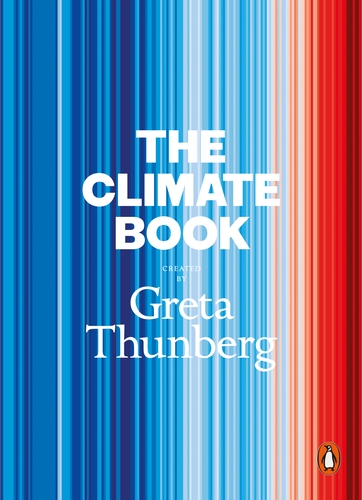
Greta Thunberg (Author)
We still have time to change the world. From Greta Thunberg, one of the world's leading climate activist, comes the essential handbook for making it happen.
You might think it's an impossible task: secure a safe future for life on Earth, at a scale and speed never seen, against all the odds. There is hope - but only if we listen to the science before it's too late.
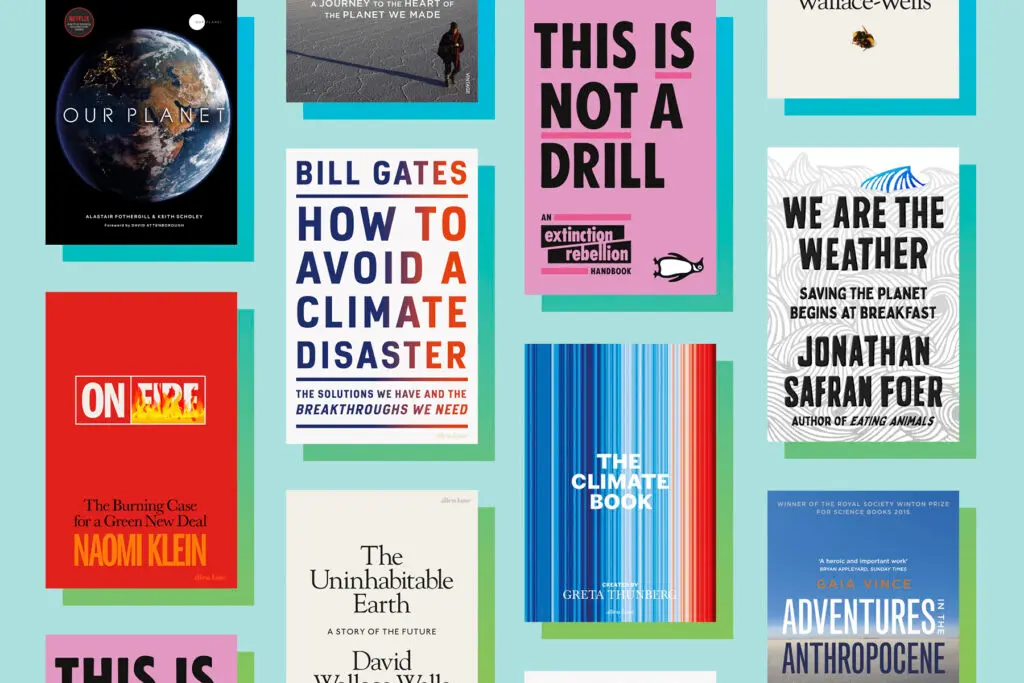
In The Climate Book, Greta Thunberg has gathered the wisdom of over one hundred experts - geophysicists, oceanographers and meteorologists; engineers, economists and mathematicians; historians, philosophers and indigenous leaders - to equip us all with the knowledge we need to combat climate disaster. Alongside them, she shares her own stories of demonstrating and uncovering greenwashing around the world, revealing how much we have been kept in the dark. This is one of our biggest challenges, she shows, but also our greatest source of hope. Once we are given the full picture, how can we not act? And if a schoolchild's strike could ignite a global protest, what could we do collectively if we tried?
We are alive at the most decisive time in the history of humanity. Together, we can do the seemingly impossible. But it has to be us, and it has to be now.
Dipo Faloyin (Author)
A bright portrait of modern Africa that pushes back against harmful stereotypes to tell a more comprehensive story.
'Warm, funny, biting and essential reading.' Adam Rutherford
'An exhilarating journey through the myths, misconceptions and stereotypes of modern Africa. This book is the history lesson that we all need.' Jeffrey Boakye, Guardian
You already know these stereotypes. So often Africa is depicted simplistically as an arid red landscape of famines and safaris, uniquely plagued by poverty and strife.
In this funny and insightful book, Dipo Faloyin offers a much-needed corrective. He examines each country's colonial heritage, and explores a wide range of subjects, from chronicling urban life in Lagos and the lively West African rivalry over who makes the best Jollof rice, to the story of democracy in seven dictatorships and the dangers of stereotypes in popular culture.
By turns intimate and political, Africa Is Not A Country brings the story of the continent towards reality, celebrating the energy and fabric of its different cultures and communities in a way that has never been done before.
'Hilarious, ferocious, generous and convincing. It made me reconsider almost everything I thought I knew about Africa.' Oliver Bullough
'This book should be on the curriculum.' Nikki May, author of Wahala
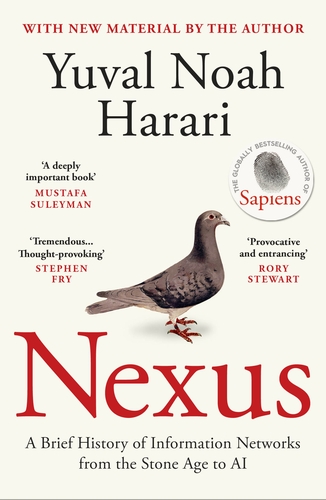
Yuval Noah Harari (Author)
For the last 100,000 years, we Sapiens have accumulated enormous power. But despite all our discoveries, inventions and conquests, we now find ourselves in an existential crisis. The world is on the verge of ecological collapse. International and political tensions are rising. And we are rushing headlong into the age of AI – an alien information network that threatens to annihilate us. For all that we have accomplished, why are we so self-destructive?
Nexus looks through the long lens of human history to consider how the flow of information has brought us here. Taking us from the Stone Age through the canonisation of the Bible, the invention of print, the rise of mass media and the recent resurgence of populism, Yuval Noah Harari asks us to consider the complex relationship between information and truth, bureaucracy and mythology, wisdom and power. He explores how systems like the Roman Empire, the Catholic Church and the Soviet Union have wielded information to achieve their goals, for good and ill. And he addresses the urgent choices we face as non-human intelligence threatens our very existence.
Information is not the raw material of truth, nor is it a mere weapon. Nexus explores the hopeful middle ground between these extremes and, in doing so, rediscovers our shared humanity.