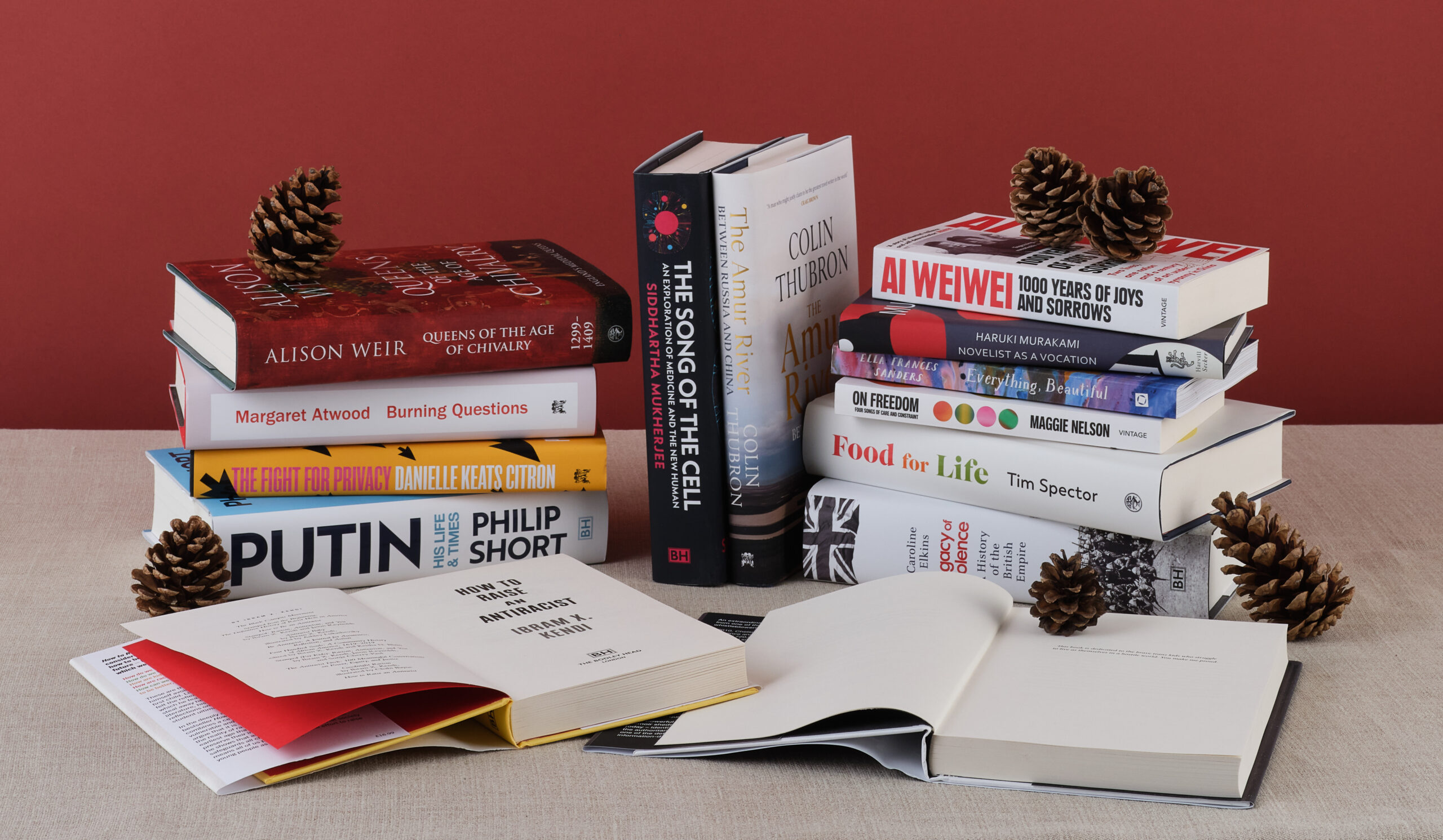
A non-fiction book can teach us new things, change our perspectives, offer inspiration and surprise us. That’s why giving a non-fiction book as a present means you’re giving more than just a book; you’re sharing an idea, offering up knowledge and telling someone you want to share a discussion with them.
Here are fifteen books, perfect for giving the gift of an idea.
The author of novels including IQ84 Norwegian Wood Murakami T ,
Now, fans get to delve deeper into his mind with Novelist as a Vocation , in which Murakami gives readers an insight into his craft.
Sharing his thoughts on subjects including what he thinks about being a novelist, his thoughts on the role of the novel in our society and his own origins as a writer, Novelist as a Vocation sheds light on the mastery and mystery of Murakami the writer, and only increases the magic.
'What do you want to eat?' It’s a question that many of us ask ourselves and each other every day. And the answer, as we face climate change, allergies and intolerances, confusing labelling and supply-chain problems, is getting more complicated.
In Food for Life , scientist Tim Spector draws on over a decade of cutting-edge research and his own personal insights to tell us everything we should know about food today. This is a practical book that offers a new approach on how to eat in a way that is best for our health and the health of the world we live in.
Shortlisted for the Baillie Gifford Prize for Non-Fiction, Caroline Elkins’ book is a landmark study of the British Empire, focusing on the way in which it employed violence in the 20th Century and the ways it tried to cover this up by destroying and hiding incriminating evidence.
Looking at 200 years of history, Elkins outlines the evolutionary and radicalised doctrine used to preserve Britain’s imperial interests across the world. Elkins investigates events including the Indian Mutiny, the Morant Bay Rebellion, the South African War, the Irish War of Independence and more, and doesn’t shy away from the details. As she says in the book’s introduction: "Failure to confront the practices diminishes the raw lived experiences in the empire and the legacy they left behind."
Though it's difficult reading at times, Legacy of Violence is an essential read if we’re to understand and confront Britain’s colonial past and its impacts on our present
The cell – tiny and only visible under a microscope – is the most fundamental unit of life; our organs, physiology and our entire selves are built from them and rely on them.
In The Song of the Cell , the follow-up to his book The Gene
Featuring the stories of scientists, doctors, and the patients whose lives may be saved by their work, The Song of the Cell is a thrilling read and a look at what it really means to be human.
You might think you know the story of Chelsea Manning, a former intelligence analyst for the US army in Iraq who disclosed, in the largest data leak in history, 720,000 classified military documents that she had smuggled out via the memory card of her digital camera.
Despite Manning declaring her gender identity as a woman and beginning to transition, she was sent to a male prison where she kept for much of the time in solitary confinement. In 2017, seven years into her 35-year sentence, President Barack Obama had it commuted and she was released.
While much of her recent life story is well known on a surface level, there is much more to Manning’s life, as she reveals in README.txt. Covering her childhood and adolescence in Oklahoma and in her mother's native Wales, a period of homelessness in Chicago, living under 'Don't Ask, Don't Tell' in the US Army, and the experience of coming to terms with her gender identity and undergoing hormone therapy in prison, this is the real story of the woman behind the headlines.
One of the world’s most famous artists and activists, Ai Weiwei, intertwines his own story with that of his father, the celebrated poet Ai Qing , in 1000 Years of Joys and Sorrows .
Here, Ai tells of how his father fell foul of authorities, and how he himself moved to America as a young man before returning to China. The book also recounts his rise to becoming an art world superstar, and how his work has been shaped by living under a totalitarian regime.
With China such a dominant presence on the world stage, understanding its politics is invaluable. Through his own story and that of his father, Ai tells the tale of China over the last 100 years, from the Cultural Revolution through to the modern-day Chinese Communist Party.
If you were asked to name some of the most famous rivers in the world, it would be unlikely that the Amur River would be on your list. But this body of water, which rises in the Mongolian mountains and flows through Siberia to the Pacific, forms the border between Russia's far east and Northeastern China, and is the most densely fortified frontier on Earth.
In The Amur River , travel writer Colin Thubron takes a journey from the source of the river to its mouth, covering almost 3,000 miles. This account of his journey covers his battles with injury, his arrest by local police, and his visits to the Chinese and Russian shores, and is all the more remarkable considering Thubron was 80 when he undertook the trip.
Freedom of speech, freedom to protest, freedom to wear what we like, freedom to vote. Discussions around freedom and its meaning can seem never-ending and opaque, getting increasingly complicated the more we try to discuss it.
Step forward Maggie Nelson, who in this clear-sighted book explores how we might think, experience or talk about the concept of freedom in useful ways.
Drawing on pop culture, theory and more, Nelson looks at freedom through the prisms of art, sex, drugs and climate, and offers a new perspective on the divided and challenging times we’re living in.
Historian Alison Weir looks at the lives of five Plantagenet queens in this latest book in a series illuminating the lives of female monarchs.
Queens of the Age of Chivalry shows how Marguerite of France, Isabella of France, Philippa of Hainault, Anne of Bohemia and Isabella of Valois broke away from restrictions imposed on them as women and were more than just dynastic trophies.
The quintet all lived through the Age of Chivalry, which included turbulent events such as the Black Death, the Peasants' Revolt and the Hundred Years War against France. Covering these and more, Weir brings to life these five extraordinary women.
The previous books in the series are Queens of the Conquest , about the five queens who helped the Norman kings of England rule their dominions, and Queens of the Crusades , about Eleanor of Aquitaine and her successors.
In an age where an idea of us can be formed from our online presence alone, where our likes and dislikes can be tracked, and where our homes, workplaces and leisure haunts are surveilled, how do we keep anything private?
In The Fight for Privacy , Danielle Keats Citron – who teaches and writes about information privacy, free expression and civil rights at the University of Virginia School of Law – looks at the threat we face from a lack of privacy. Containing interviews with victims of privacy loss, activists and lawmakers, Citron looks at how our laws have failed to keep up with our technological world and argues for a reassessment of privacy as a human right.
Through her fiction, Margaret Atwood has proved remarkably adept at seeing our world, and its impending problems, clearly (The Handmaid’s Tale , anyone?). She’s just as clear-headed a writer of non-fiction, honing her ideas on a variety of topics, coupled with her own brand of humour.
Burning Questions is a collection of fifty essays in which Atwood discusses everything from the climate crisis to freedom and zombies. Don’t be surprised if this book is still as relevant in twenty years as it is now.
As the war in Ukraine continues and accusations of Russian interference in international elections abound, Vladimir Putin continues to garner support at home, despite the fact that Russia is living under sanctions from the West. What is it about Putin that inspires such loyalty? And how, under his leadership, did Russia become a force to be reckoned with?
In his biography, Philip Short – who worked as a foreign correspondent for the BBC in places including Moscow and Russia – explores Putin’s personality and destroys preconceptions about his Russia.
Short spent eight years researching and writing this book, working mainly from sources within Russia, but also in Britain, France, the United States and a dozen other countries. This book will offer a deeper understanding of a man on a mission to restore Russia to greatness.
Originally published in 1934 and reissued in this new Vintage Classics edition, this collection of fourteen short stories was written by Langston Hughes during the year he spent living in Carmel, California.
Concerned with racial tensions, the stories in the book include a tale about a Black maid who forms a close bond with the daughter of the cruel white couple for whom she works, and that of a white-passing boy who ignores his mother when they cross each other on the street.
Witty and observant, these stories are as relevant today as when first written.
In Everything, Beautiful , Ella Frances Sanders invites us to rethink what ‘beauty’ can be, and posits that the we can find it all around us if we just stop to look; it's part manifesto, part guide and part journal.
The book includes inspirational quotes, breathtaking illustrations and space for readers of all ages to write, draw and reflect on their own ideas of beauty. It’s a perfect book to help you reclaim your sense of wonder and take time to breathe and appreciate the world around you.
As the founding director of the BU Center for Antiracist Research and the author of the global bestseller, How to Be an Antiracist, Ibram X. Kendi was initially unsure about whether it was necessary to approach his work within the context of his newest challenge: becoming a father. Not wanting to ruin the innocence of his child, he avoided the topic out of a protective instinct. Tapping into a depth of scientific research with his own personal journey, Kendi argues that teaching our children about antiracism, the realities of racial oppression and the myth of race is the best way to look after our children and build a better, more antiracist world for them. It’s an ideal read for any parent.